TL;DR
Why Human Judgment in AI-Driven Markets Still Matters
But it cannot replace:
- human judgment
- ethical decision-making
- cross-context strategy
- systems design
- trust and relationship capital
As generative engines compress execution, judgment becomes the scarce variable.
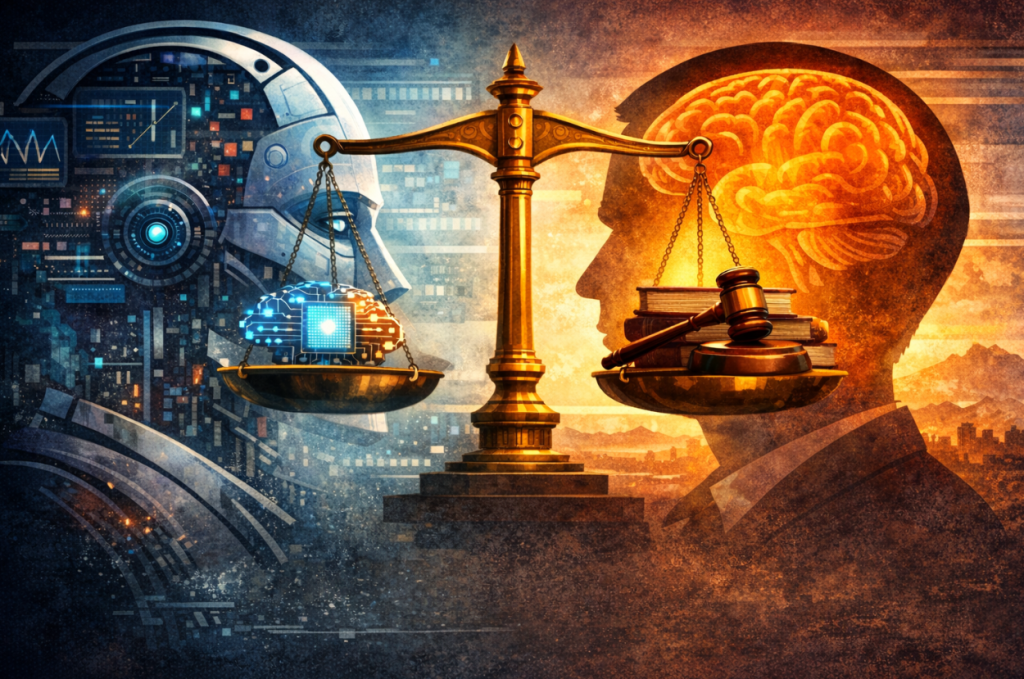
The real question for leaders right now isn’t whether AI is improving. It’s how human judgment in AI-driven environments becomes the last durable advantage.
If your organization isn’t systematically cultivating judgment, you’re outsourcing advantage to algorithms.
This article explains why judgment matters, what it is, and how to build it into your strategy so your company isn’t just “AI-enabled” — it’s AI-leader ready.
The Paradox of Abundant Cognition
AI compresses execution:
- Reporting
- Drafting
- Summarization
- Testing
- Code generation
- Content creation
These tasks become abundant because AI handles them.
Leadership isn’t “out of a job.”
It’s out of traditional tasks.
When execution becomes cheap, the remaining scarcity is:
Which decisions get made, and on what basis?
That scarcity is judgment.
What Most Organizations Get Wrong
Most teams still optimize for:
- Speed
- Efficiency
- Output volume
- Lower costs
These were the right priorities in a world where execution was scarce.
Now execution is abundant.
Optimization becomes necessary, not decisive.
This is exactly why traditional models like attribution break in AI environments. For a practical model on that, see Why Attribution Breaks in AI-Driven Funnels.
Efficiency alone does not create sustainable advantage.
Judgment does.
What Judgment Actually Is (In a World Where AI Doesn’t Sleep)
Judgment is the ability to:
- Interpret ambiguous signals
- Choose between competing priorities
- Assess long-term consequence vs. short-term gain
- Weigh ethical implications
- Align decisions with human values
- Predict and plan in novel contexts
AI can simulate competence.
AI cannot truly choose values.
That is judgment.
Why Judgment Matters Most in 2026
AI can outperform humans on:
- Pattern recognition
- Execution speed
- Multi-step workflows
- Data synthesis
- Scenario testing
But it cannot replace:
1. Ethical Decision-Making
When algorithms trade off outcomes, they don’t judge why the outcome matters.
2. Contextual Strategy
Humans connect dots across unrelated domains — and prioritize.
3. Trust & Social Capital
AI can generate words. It can’t build trust.
4. Cross-Disciplinary Insight
Judgment integrates knowledge across functions.
AI remains domain-specific in how it generalizes.
That’s your advantage.
Judgment vs. Optimization: A Simple Test
If your org still evaluates success by:
❌ Lower CAC
❌ Faster deployments
❌ More content
❌ More reports
…then you are optimizing execution.
If your org evaluates success by:
✅ Better positioning
✅ Superior judgment in ambiguous environments
✅ Strengthened narrative unity
✅ More reliable decisions under change
…then you are cultivating judgment.
This difference is what separates AI adopters from AI leaders.
How to Build Judgment as an Organizational Capability
Here’s a practical framework.
1. Design Decision Frameworks
Make explicit:
- assumptions
- trade-offs
- decision criteria
Generative engines don’t create frameworks — humans do.
2. Run Decision Rehearsals
Use AI to simulate scenarios, then validate assumptions with human judgment.
3. Measure Leading Indicators, Not Just Outcomes
Look upstream:
- Are decisions reducing uncertainty?
- Are they increasing signal stability?
- Are they prioritizing trust?
See how this complements AI discoverability by reviewing How to Audit Your AI Discoverability in 30 Minutes.
4. Cultivate Narrative Discipline
AI can mimic style — not intent.
Clear organizational narratives reduce ambiguity.
5. Invest in Continuous Learning
AI changes fast. Judgment matures slowly.
Create learning loops that:
- scan trends
- evaluate decisions
- synthesize insight
Judgment without learning decays.
Frequently Asked Questions About Judgment in AI
Is judgment relevant if AI tools get better?
Yes. Tools execute. Humans decide why and what.
AI lacks enduring human values.
Can AI help improve judgment?
AI can simulate possibilities, but final assessment must come from humans.
AI accelerates data synthesis, not value alignment.
How do I measure judgment as a capability?
Look at:
- decision quality
- consistency
- ethical coherence
- strategic depth
- cross-team alignment
The Competitive Edge
Execution, reporting, optimization — all can be automated.
But judgment — the capacity to prioritize, to weigh ethics, to synthesize context — remains human.
As execution becomes abundant and AI compresses cognition, judgment becomes the true scarcity.
The brands that cultivate judgment internally outperform those that outsource it to algorithms.
That’s not fear.
That’s leverage.
What Comes Next
I’ll be exploring:
- How to design executive dashboards for judgment-led teams
- How to hire and train AI-native strategists
- How to measure judgment as an organizational KPI
- How to integrate AI into cross-functional decision workflows
Because AI is not about replacing humans.
It’s about reallocating what humans are best at.
Further Reading & Research
The trends discussed in this article are supported by ongoing research and reporting from the following institutions:
- Anthropic Research on AI Capability Scaling
https://www.anthropic.com/research - OpenAI Technical Research & Model Development Updates
https://openai.com/research - METR – Measuring AI Task Autonomy & Performance Growth
https://metr.org - Stanford AI Index Report (Annual AI Benchmarking Report)
https://aiindex.stanford.edu/report/ - McKinsey: AI, Automation & Knowledge Work Analysis
https://www.mckinsey.com/capabilities/quantumblack/our-insights