Most marketing teams say they want attributable growth.
What they actually have is channel reporting.
There’s a difference.
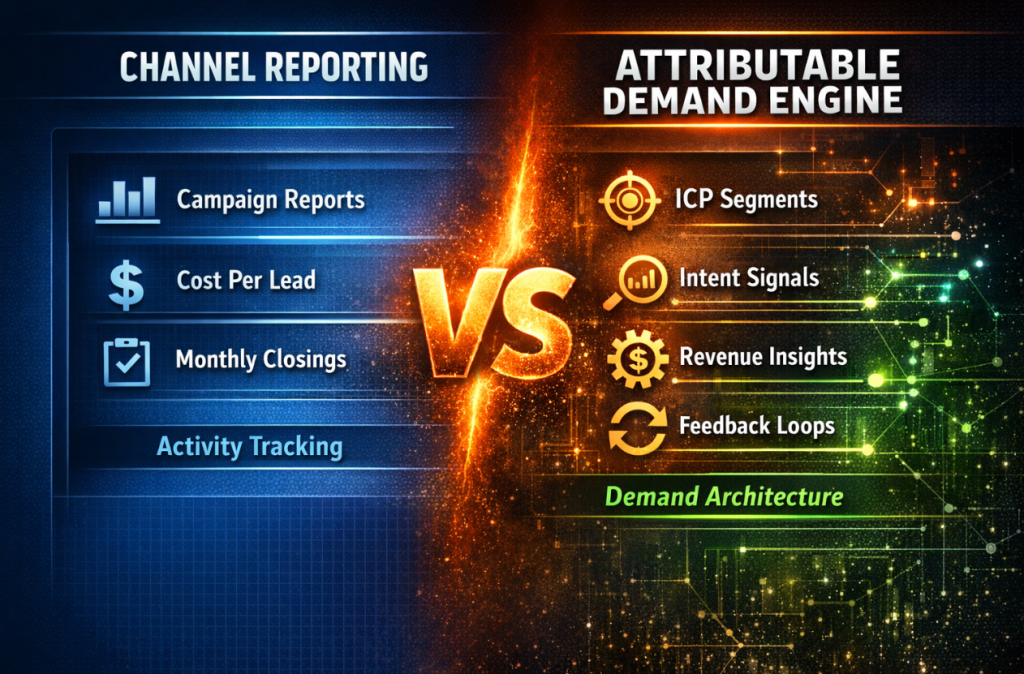
Channel reporting tells you:
- What campaigns ran
- What CPL was
- What closed last month
An attributable demand engine tells you:
- Which segments move first
- Which behaviors predict pipeline
- Which signals indicate buying intent
- Which inputs reliably produce revenue
One measures activity.
The other engineers demand.
The Illusion of Attribution
Attribution models often look sophisticated.
Multi-touch.
Weighted.
Dashboarded.
But if the underlying system isn’t built around:
- Defined ICP tiers
- Behavioral signal scoring
- Clear handoff architecture
- Closed-loop revenue feedback
Then you don’t have attribution.
You have storytelling.
The Real Shift: Signal Architecture
Modern demand generation isn’t about “more campaigns.”
It’s about building signal architecture:
- Define high-value segments precisely
- Identify leading behaviors, not lagging conversions
- Weight signals across channels
- Align marketing and sales on which signals matter
- Feed outcomes back into the model
When done correctly, marketing stops asking:
“What worked?”
And starts asking:
“What reliably produces pipeline?”
That’s the difference between marketing as a function and marketing as an engine.
Why This Matters Now
AI-driven discovery is compressing traditional funnels.
Buyers are:
- Researching anonymously
- Using AI summaries
- Comparing vendors before visiting your site
If your system only attributes last-click activity, you’re missing the actual demand formation.
The companies that win won’t be the loudest.
They’ll be the ones with signal clarity.
The Bottom Line
If your demand strategy depends on campaign performance reports, you have reporting.
If it depends on signal design, ICP precision, and revenue feedback loops, you have an engine.
And engines compound.