Every marketing report I have seen at a financial institution has a cost line and a results line, and the two were built by different people from different systems. The CFO knows it. Close that gap and marketing becomes the easiest budget in the building to approve, because it is the only one that comes with its own receipt.
The number that does it is cost per funded new account, by channel, for the month. Accounts opened and funded, divided into what it cost to bring them in. Here is how I build it when the inputs do not line up, which is always.
Start with the floor
Credit unions report educational and promotional expense on the NCUA call report every quarter. Banks file a marketing line too. The filed figure is public, so it is also the number a board member can look up. Across the 444 credit unions over $1 billion in assets (NCUA filings, the year to June 2026, likely mergers removed), the median is about $21 a member a year. That is a floor. Agency fees, salaries and sponsorships booked under other lines sit outside it. I use it as the first row of the cost side and then add what the ledger shows above it.
Add the invoices
Three additions, in the order I find them. Agency retainer and production, from the invoices. Sponsorships and partner payments, which are usually booked to community relations or a business development line. Rate promotions, which are a cost of funds question and belong in a footnote, since keeping them separate keeps both numbers clean. I keep salaries out of the per-account number and show them once, at the bottom, so the channel comparison is spend against spend.
Then the denominator, which is where the work is
New accounts funded in the month, by the channel that brought them, from the core. Two conditions. The account has to be funded, because a funded account is the thing the institution wanted. And the application has to carry a source. If the application form has no source field, or the field is there and the branch picks “other,” that is the first fix, and it costs nothing. One required field, six or seven values, and a rule that “other” needs a note. Add it this quarter and the number builds itself from then on.
Merged-in members or customers come out of the count. A month with an acquisition in it is a month with an asterisk.
An illustrative month
The numbers below are made up to show the math. Say $180,000 went out across four channels. Paid search, $60,000, brought 240 funded accounts, $250 each. Direct mail, $50,000, brought 125, $400 each. Social, $50,000, brought 50, $1,000 each. Branch and referral, $20,000 in materials and incentives, brought 400, $50 each. Across the month, 815 funded accounts at $221.
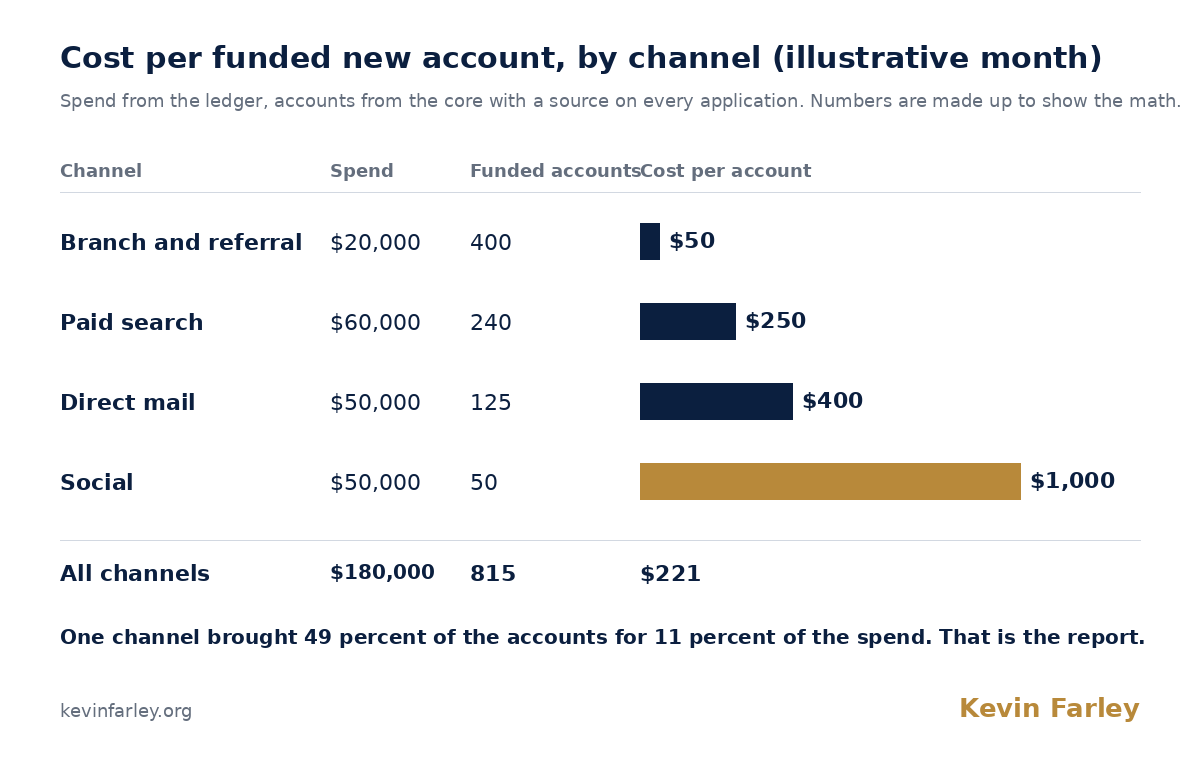
One channel brought 49 percent of the accounts for 11 percent of the spend. That sentence is the report. A CFO can read it in under a minute, and the conversation it starts is the good one: what would it take to do more of that, and what is the social budget building that the account count does not show yet? Sometimes there is a good answer. Either way, the question gets asked with a number on the table, and marketing is the one who brought the number.
What I do with the number
It goes on the first page, four lines, this month and last. Under it, one paragraph: what changed and why. The cost per account went up in paid search because a competitor entered the auction; direct mail fell because the list was cut to the two counties where the branches are. Nobody needs the dashboard behind it. They need the four lines and the paragraph, every month on the same day, so the trend is the story and the trend is yours.
What I leave for the channel managers
Impressions, reach, clicks and open rates. They are useful to the people running the channels, and they belong on their pages. Brand spend gets its own line with no account count against it, labeled as brand, so a billboard is counted as what it is and the funded accounts stay clean.
If your marketing report cannot produce cost per funded new account by channel for last month, the fix starts with one field on the application. Add it this quarter, and by the time the 2027 budget comes around, the number will be sitting on the table with two months of history behind it, and the person who put it there will be the one the CFO wants in the room.