On November 10 OpenAI opened something it calls Businesses in ChatGPT. Any company in a country where ChatGPT operates can now search for its own listing, prove it owns the business, and correct what ChatGPT says about it. It is a beta, and the parts that matter to a financial institution are free for now.
I have watched Google go through the same cycle twice. First the listing exists whether you claim it or not, assembled from whatever the machine found. Then the claim opens. A year or two later, the institutions that claimed early have the hours, the addresses and the description right, and the ones that waited are explaining to a CEO why the map still shows a branch that closed years ago. ChatGPT is at step two this month.
What you can do once the listing is yours
The claim starts with a search for the institution’s name inside the Business Hub. You pick the listing or create one, then prove authority by a text or a call to the main business number, or by adding a record to the domain. After a review stage, which can include a wait, the person doing it verifies their own identity with a government ID before editing anything. Plan for the main number to ring at the switchboard and for the person answering to know why.
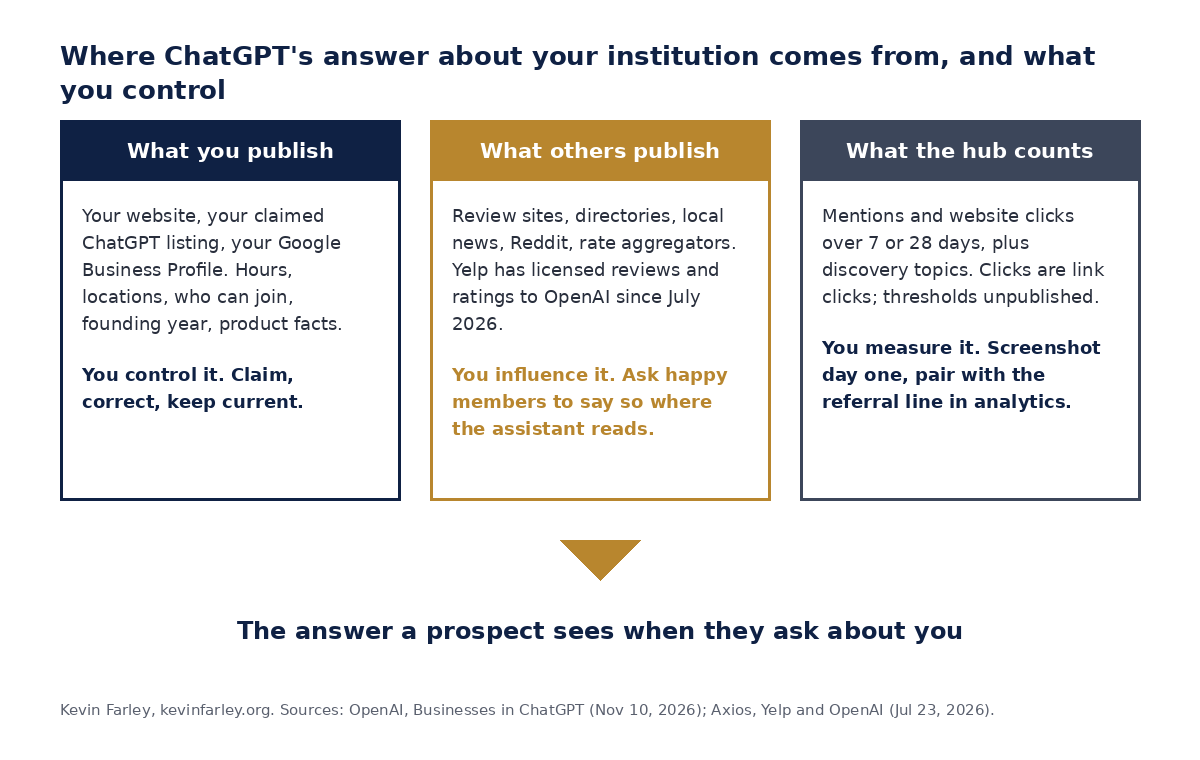
Once verified, the institution can update its key details, and ChatGPT may use what you provide when it answers a customer. There is a product feed option built for retailers that I would leave alone for now, and a Business Agent option limited to US ecommerce and online services at launch. For a bank or credit union, the prize in week one is the facts: hours, locations, the name as it should be written, the founding year, who can join.
What the Business Hub tells you
The hub reports aggregated counts of mentions and website clicks, over seven or 28 days, with a panel of discovery topics, the themes of the conversations where your site was cited. Three things to know before anyone puts a number on a slide. A brand name alone does not count as a mention. Clicks are link clicks, and OpenAI’s own help text says they do not confirm a visit or a conversion. The counts appear only above a threshold OpenAI has not published, so a smaller institution may see an empty tile for a while.
That is still more than you had last month. For the first time there is a first-party count of how often ChatGPT sends people to your site, and it can sit next to the ChatGPT referral line in your analytics so you can see whether the two move together.
The rating the claim does not touch
The part most marketing leaders have not seen yet is the star rating. Since July, Yelp has licensed its reviews, ratings and photos to OpenAI for local answers. When someone asks ChatGPT about a branch, the card can carry a Yelp rating with the Yelp logo, even when the branch has a handful of reviews there and a thousand on Google. A claimed listing lets you fix the facts. The rating comes from asking the members who are happy to say so on the site the assistant reads, which for the moment means Yelp as well as Google.
What I would do this week
Decide who owns the claim. In most shops it is the person who owns the Google Business Profile, and the two jobs belong together. Have them claim the listing, correct the basics, and screenshot the Business Hub on day one so there is a baseline. Pull the ChatGPT referral line from analytics for the last 90 days and set it beside the screenshot. Then ask ChatGPT the five questions a prospect asks about you, the way a prospect would ask them, and write down what it says and where it got it. That page of notes is the start of an AI answer program, and it costs an afternoon.
The institutions that claimed their Google listing in the first year spent the next decade with the right hours on the map. The window on ChatGPT opened on November 10. The person who picks up the phone at the switchboard this week is the one the CEO will thank next year.