There is a read I do in client work now. I search the institution’s name, open page one, and skip every result the institution wrote.
What is left is thin. A review site with a star rating built on a handful of old reviews. A business profile with numbers that do not match the About page. A Reddit thread or two, often kinder than the reviews. And often no Wikipedia article at all.
Why I started in September
Two trackers reported the same change within a day of each other.
DemandSphere follows a set of branded searches every day. Google showed an AI Overview on 26 percent of them on September 1. The number sat around 30 percent for most of the month. It hit 90 percent on September 27 and was 82 percent on September 29, the last day in the data.
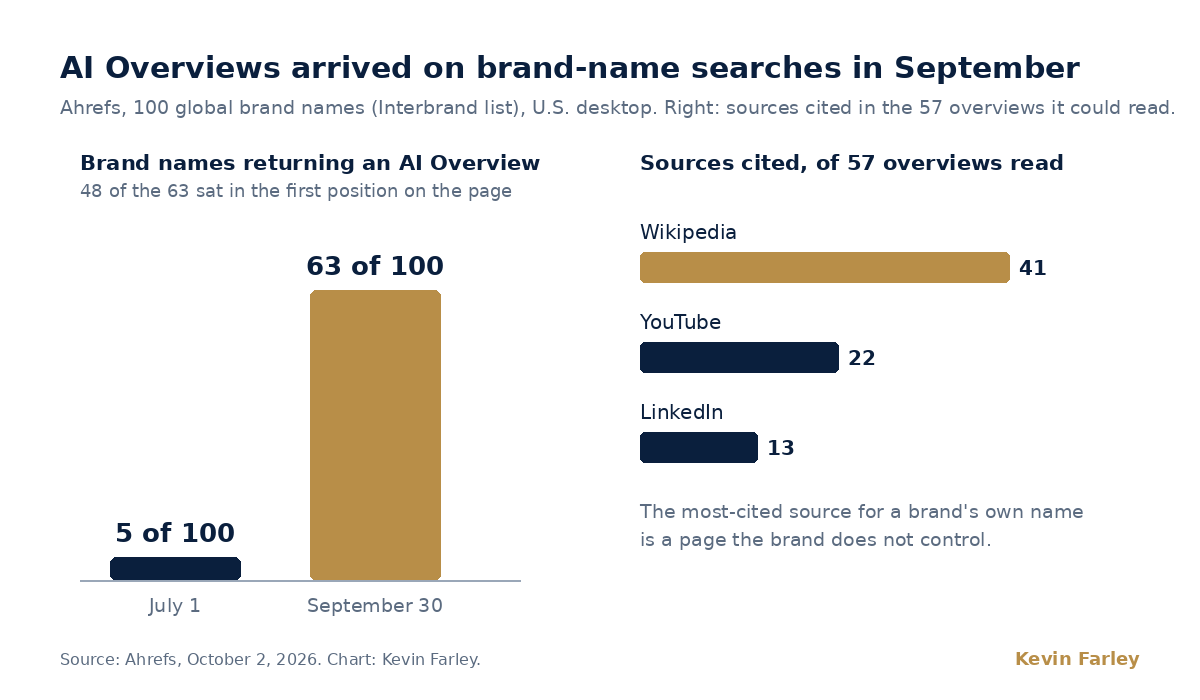
Ahrefs published the more useful study on October 2. It crawled U.S. desktop results and found overviews on 65 percent of branded keywords in August and 73 percent in September. Then it took 100 bare brand names from Interbrand’s global list. On July 1, five of them returned an overview. On September 30, 63 did, and 48 of those 63 sat in the first position on the page.
The two trackers do not agree on where the month started. DemandSphere has not said how many searches it follows or which brands. Ahrefs shows its work, so I lean on Ahrefs. None of these studies measured clicks, and Google has announced nothing.
I also cannot tell you how often a regional institution’s name gets an overview. These are global brands. In my own runs on financial questions, the same search can show an overview in the morning and none that afternoon.
What the summary cites
This is the finding I would act on. Ahrefs could read the source list for 57 of those overviews. Wikipedia was cited in 41 of them. YouTube was in 22 and LinkedIn in 13.
The most-cited source for a brand’s own name was a page the brand does not control. Many community banks, credit unions and smaller asset managers have no Wikipedia article. I do not know yet what Google reaches for when that source is missing. My guess is the same third-party pages I listed at the top, and that is a guess.
Regulated institutions have a filed record
When a profile and an About page disagree, a financial institution can look up which is right. Credit unions file assets and member counts with NCUA every quarter. Banks file with the FDIC. Branch lists and charter dates are in both agencies’ public institution records. An investment adviser’s Form ADV works the same way, and a fund’s prospectus states the expense ratio a review site may have copied wrong.
Most businesses have nothing like that.
Run it on your competitors
Do the same read on the two or three institutions closest to yours. You will see who has the thinner record and whose numbers disagree across sources.
That is competitive intelligence. We built a tool at Atlas called FI Snapshot that reads any bank or credit union from its NCUA or FDIC filings. FI Snapshot pulls the filed numbers. The name search shows what public pages say. The gap between them is the finding.
One afternoon
Search your name, your name plus “reviews,” and “is” plus your name plus “good.” Do it logged out.
Write down every page-one site you do not control. Open each one and check assets, branch count and, for a credit union, members against the filed record. For a fund, check the expense ratio against the prospectus.
Fix what you can log into. For the rest, write down who can.
Run the same three searches on two competitors and put the lists side by side.
Check again in 30 days. Ahrefs says Google may change or reverse this.
I would put the result in the competitive report, on the same page as growth. In my experience nobody owns it.