
The first thing I ask for on a marketing effectiveness engagement is the spend, by vendor, by month, as it was paid. The budget comes later. The second thing I learn is that nobody in the building has that in one place.
Finance has the general ledger. Marketing has a tracker, usually a spreadsheet built around the media plan. Each vendor has its own report. All three describe the same dollars, and in every engagement I have run they disagree, for reasons that have nothing to do with anyone being careless.
Why the three books differ
Finance books by payment month. A television package for the fall runs in September and October and may be paid in November, or paid in August as a prepay. The ledger is right and it is also useless for asking what September’s spend bought in September.
Marketing tracks by plan. The tracker says what was bought and for how much, laid out across the months the campaign was supposed to run. It rarely gets updated when an invoice comes in short, a make-good is issued, or a flight moves.
Vendors report by delivery. Impressions, spots, clicks. Their totals are often the only record of what actually ran, and they arrive as PDFs in an inbox, never in the same layout twice.
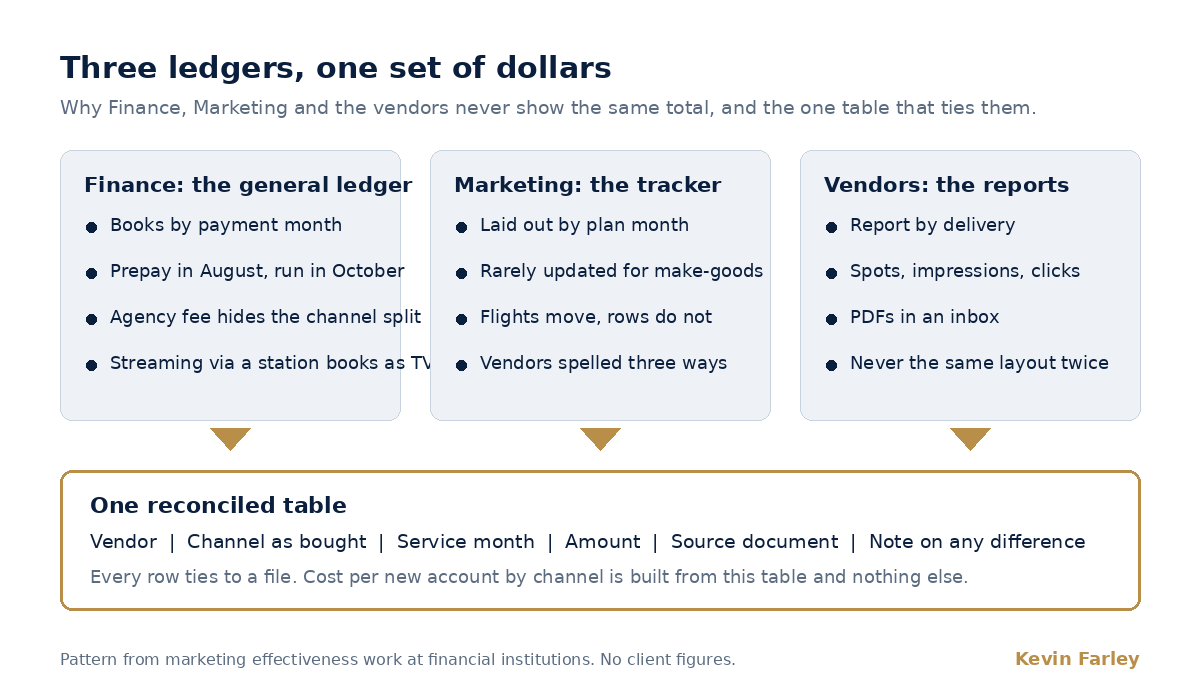
Then there are the account structures. A digital agency’s invoice can sit in a general media account, so the search and social spend inside it is invisible until someone asks the agency for the split. Streaming video bought through a local television station books as television. Sponsorship money sits in a partnerships account with the stadium’s name on the line and nothing about what it bought.
None of this is anyone’s fault. Each ledger answers the question its owner is asked. Finance is asked whether the bills were paid. Marketing is asked whether the plan was executed. The vendor is asked whether the campaign delivered. Nobody is asked, in one place, what the dollars bought.
What reconciling looks like
I build one table. Vendor, channel, service month, amount, source document. Every row ties back to a file: a ledger extract, an invoice, a vendor report. Where the ledger says one thing and the tracker another, the row carries both and a note on why.
The first pass always turns up a few things. A vendor spelled three ways across the systems. A month where the ledger’s own total row leaves out an account. A duplicate payment counted once by Finance and twice by the tracker because it was filtered on different dates. Each one is small. Together they are the difference between a report leadership trusts and one they argue with.
Then I add a channel column that reflects what the money actually bought, whatever account it was booked to. Streaming is streaming even when the invoice came from a TV station. Search is search even when it arrived inside an agency fee. Only after that can you say what share of the budget reached people who were already shopping, and what share went to building the name.
What this has to do with growth
Everything downstream depends on it. Cost per new account by channel is spend by channel over new accounts traced to that channel. If the spend side is a guess, the cost side is a guess with a decimal point.
And the report has to carry the gap openly. The web analytics count of completed applications will never equal the number of accounts actually opened, because part of the process finishes offline. The ledger total will never equal the tracker total, because one is paid and one is planned. The job is to know why they differ and by roughly how much, so leadership stops arguing about the gap and starts using the trend.
If you run marketing at a financial institution
Ask Finance for a vendor-by-month extract of every marketing account for the last 24 months. Ask your agency for the channel split behind every invoice. Put them in one table with your own tracker and see how far apart they are. Most teams I work with have never done it, and the first version takes an afternoon. It is the least glamorous work in marketing and the most useful thing I did this quarter.