TIME published a piece on September 29 about how Google has been moving ordinary searchers into AI without most of them noticing. The number that will get repeated is Google’s own: more than 1 billion monthly users of AI Mode. I take company-reported numbers with some care, and I would guess that count includes plenty of people who tapped the button once.
The rest of the picture is harder to wave off. Similarweb puts AI Overviews on 40 percent of U.S. Google searches. Pew found that 60 percent of Americans read the AI summary at the top of their results, which is more than the 49 percent who use a chatbot at all.
The detail I keep coming back to is smaller. Kevin Indig, who writes Growth Memo and studies how people behave in AI Mode, told TIME that queries there run about three times the length of a traditional search. People use it to plan trips, build study guides, and ask for financial advice. And once they are in, they are more likely to stay in than to go out to the web.
The short question and the long one
For most of my career the search question was short. “Auto loan rates Austin.” “Best CD rates.” “Target date fund fees.” We built websites for that. A rates page, a product page, an apply button. It worked, and it still works for the person who types four words.
The long question sounds different. “We have two car payments and about $9,000 on credit cards. Should we refinance the cars or take a personal loan to clear the cards first?” Or: “I am 52 with a 401(k) at an old employer. Roll it, leave it, or move it to an IRA, and what does each cost me?” Nobody typed those into Google five years ago. They asked a brother-in-law, or a loan officer or an adviser if they already had one.
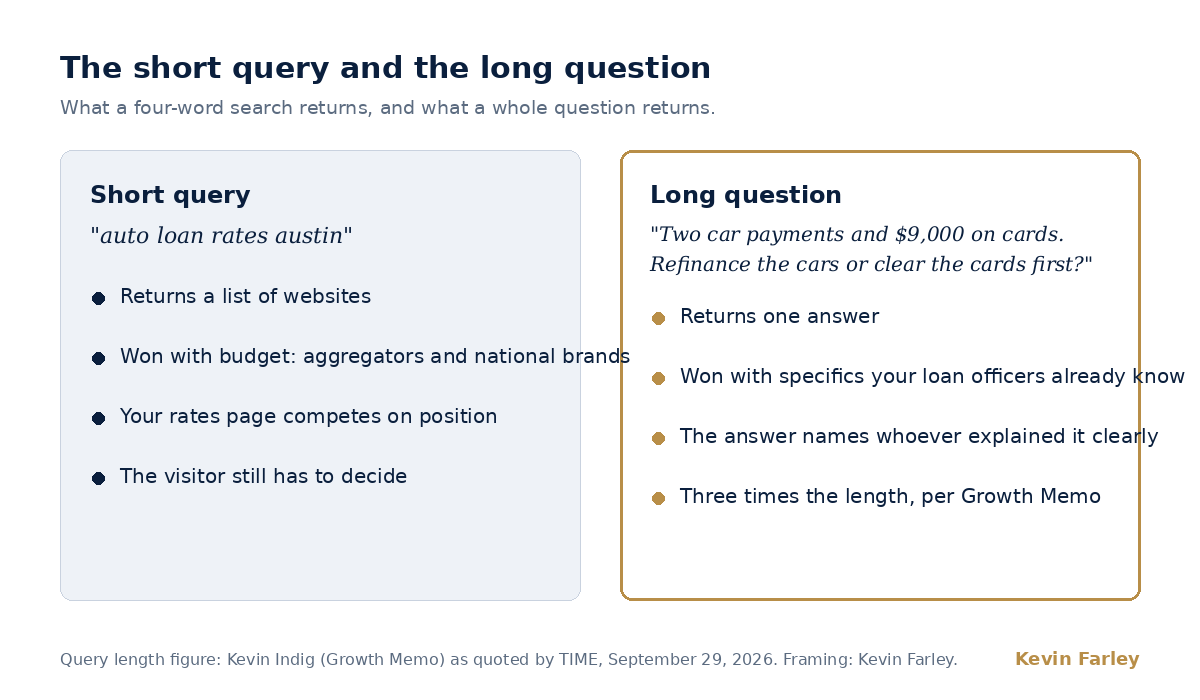
A short query gets a list of websites. A long question gets an answer, and the answer names whoever explained the thing clearly.
What I see in client work
When I open search data for a financial institution, the large majority of clicks come from queries that contain the institution’s name. I said this to a client team recently: most of your traffic already knows who you are. That is good news. It is also a ceiling.
The room to grow is in the questions with no name in them, asked by someone in the middle of a decision. For those, the typical institution’s site has almost nothing to say. The product page describes the product. It does not answer the person’s situation.
One team I work with has started on this. They are writing a plain, one-sentence definition into the top of each product page and building sets of real questions beside it. It is unglamorous work. It is also the right work.
Why I think this is a fair fight
Short queries were won with budget. Bankrate, NerdWallet and the national brands could outspend any regional institution on “best savings rate,” and they did.
Long questions are won with specifics. And here is what I did not appreciate when I ran marketing: the best answers to those questions were already inside the building. They lived in the heads of loan officers, advisers and the call center. People who had explained the refinance-or-consolidate choice hundreds of times and could do it in two minutes. We never wrote any of it down. At best it became a brochure.
That knowledge is what an AI answer is looking for. A national aggregator cannot fake it.
The honest caveat
If people stay inside AI Mode, you will not see most of them. There may be no visit to count. Being named in the answer is the win, and I suspect it shows up weeks later as one more person searching for you by name.
I cannot prove that from analytics yet. I would be suspicious of anyone who says they can.
Where I would start
Ask your front line for the ten longest questions they heard this month. Write each answer on the site the way your best loan officer or adviser would say it, with real numbers and a clear statement of who you serve and where. One page per question.
Ten pages will not change your year. They will tell you whether your institution can answer a whole question in public. Most cannot yet, and a billion people are getting used to asking.