Famous and invisible are not opposites. A brand can be both at the same time. I went looking for that gap in financial services, and it was bigger than I expected.
Here is a sentence I did not expect to write this year. A financial institution can be famous and invisible at the same time.
Famous to people, because the name is on the building, the ballpark, the checking account your parents opened for you. Invisible to the machine, because when someone opens an AI assistant and asks for a recommendation, the model reads the website, cannot make sense of it, and leaves the institution out of the answer entirely. Two kinds of visibility, and they no longer move together.
That gap is exactly what I have been helping banks and credit unions see. So I stopped theorizing about it and started measuring. The first 420 audits surfaced a pattern I have not been able to stop thinking about.
The number that stopped me
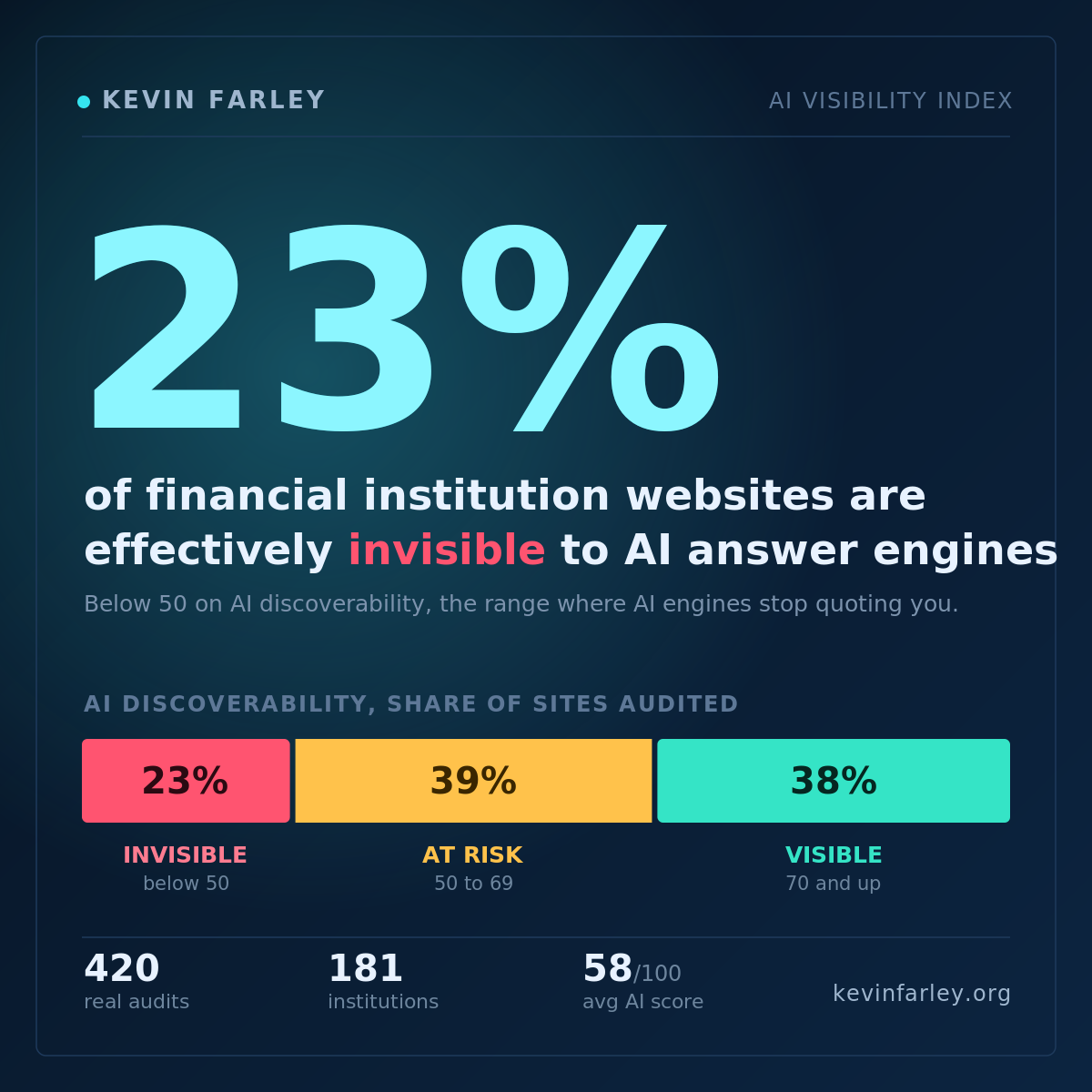
Almost 1 in 4 sites scored below 50 on AI discoverability. In plain terms, that is the range where the model basically cannot read you. Not weak. Not underperforming. Invisible. Another big group sat in a middle band, present in some answers and missing from others. Only about a third of the institutions showed up reliably. The average score across the whole set landed at 58 out of 100, which sounds fine until you translate it: the industry is a coin flip in the exact moment a future member is asking for advice.
Think about where that question gets asked now. Not on your website. Inside a chat window, in private, before the person has ever clicked anything you control. If the model names three institutions and you are not one of them, you did not lose a lead. You were never in the room.
The part that should make every marketer uncomfortable
I assumed the results would sort by size. Big banks on top, small credit unions at the bottom, roughly in order of budget. They did not sort that way at all.
Some of the most recognizable names in the country landed in the bottom third. A handful of regional credit unions, with clean and well-structured sites, landed near the top, ahead of institutions many times their size. The brand equity that took years and real money to build did not carry into the AI answer. The model does not care how many branches you have. It cares whether it can read your site.
The brand equity that took years and real money to build does not carry into the AI answer. The model does not care how many branches you have. It cares whether it can read your site.
I keep going back and forth on how to feel about that, and I have landed on both at once. It is alarming, because the moat you thought you had does not exist in this new channel. And it is hopeful, because it means a mid-size credit union can beat a national bank in the place people are actually asking for a recommendation, without a national budget. You just have to be legible.
Memorable is not the same as legible
For as long as any of us have been doing this, marketing was a memory contest. Be the name people recall when the need shows up. Buy the awareness, earn the recall, win the moment. Every tactic pointed at a human brain.
AI quietly changed the contest to a legibility test. Now there is a second reader, and it is a machine. It does not respond to a clever campaign or a decade of goodwill. It responds to structure. Can it tell who you are, what you offer, and where. Can it lift a clean, factual claim off your site and trust it enough to repeat it. When I look at what actually separated the top of the list from the bottom, it was rarely content volume. It was structured data, consistent information, and accessible, well-built pages. The unglamorous stuff. The stuff that makes a site readable to a screen reader is most of what makes it readable to a model.
That is the reframe I cannot shake. We spent twenty years optimizing to be remembered by people. Almost nobody has started optimizing to be legible to machines. Same stakes. Different skill. And the switch happened without an announcement.
If you run marketing at a bank or credit union
You do not need to panic, and you definitely do not need to go write fifty more blog posts. The first move is smaller and more boring than that. Find out what the AI actually sees when it looks at you, then fix the structure before you touch the content. Make sure a model can identify you, understand your products, and quote you cleanly. That work tends to show up in the answer faster than anything else, and it is mostly a one-time investment in getting the foundation right.
Then measure it on a schedule, against the real questions your future members are asking. One audit is a snapshot you can argue with. A trend line is a fact you can manage to.
Where I land on it
I think this becomes a standing part of every financial marketing team inside two years. Not a side project. A named responsibility, with a budget and a number attached to it, because AI-mediated discovery is turning into the front door of the whole funnel. The institutions that start looking now, while the field is wide open, are going to own the answer in their category before their competitors even realize there was an answer to own.
Most teams have never seen themselves through an AI’s eyes. That is the part I can hand them, and it is one of my favorite conversations to have right now. If you are curious where your institution stands, reach out. No pitch. Just your data, and an honest read of what it says.
Frequently asked
What does invisible to AI actually mean?
It means that when someone asks an AI assistant to recommend a bank or credit union, the model cannot read your site well enough to include you in the answer. You can be a familiar name to people and still be missing from the response. In the audit set, sites scoring below 50 on AI discoverability fell into that range, and that was almost 1 in 4 of them.
Why does brand size not help?
Because the model is reading a website, not remembering a brand. Several national names landed in the bottom third of the audit while smaller credit unions with clean, well-structured sites ranked near the top. AI visibility is about legibility to a machine, not offline recognition.
What should a marketing team do first?
Fix structure before adding content. Structured data was the most common missing piece across the audited sites. Consistent entity information and accessible, well-marked-up pages let a model read and quote you. That work moves the needle faster than publishing more.
Related reading
- AI Visibility in Financial Services: Benchmarks
- What 404 AI Visibility Audits Reveal About Where Financial Institutions Are Losing
- I Asked Five AI Tools to Recommend a Credit Union. Here Is What They Said.
See what AI says about your brand
I built a 90-second self-check that scores how visible your brand is to ChatGPT, Gemini, and Perplexity. Take the self-check. Or get the next post by email:

Kevin Farley is a marketing executive and fractional CMO with more than 20 years in financial services, B2B SaaS, and fintech. He founded Atlas Instinct, an AI visibility advisory. More about Kevin · LinkedIn