I’m not a developer. I’m a marketer who got tired of guessing whether AI tools could even see the institutions I work with, so I built an audit platform to find out, and it has already run far more audits than I expected when I started.
I did not learn to code for this. I still can’t write a for-loop from memory without looking one up. What I did instead was direct an AI coding tool through months of decisions, mistakes, and rebuilds, the way an editor works with a writer rather than the way an engineer writes a spec. That distinction matters more than it sounds like it should, and it’s the part of this story I think most marketers get wrong when they assume “building a tool” requires becoming someone else.
Why I built it instead of buying one
Every vendor in this space publishes a number that flatters their own product. I got tired of taking those numbers on faith, so I decided to generate my own, on real institution websites, with a methodology I could defend line by line. That meant crawling sites, scoring them across categories that actually matter (technical health, GEO and AEO structure, reputation, SEO, accessibility), and being honest in public about where the data is strong and where it isn’t.
Data quality is the gate here. AI is just the application sitting on top of it. I didn’t fully believe that line until I’d spent a few weeks watching bad crawl data produce confident-looking scores that were, on inspection, garbage. If you want the scoring logic itself, I wrote that up separately in the methodology behind the readiness index.
The problem nobody warns you about
Here’s what surprised me most about building this as a non-technical person: the hardest part was never the AI model doing the scoring. It was figuring out when I could trust the input at all.
Some institution websites let my audit bot through cleanly. A direct crawl, real page content, a score I’d stand behind for that specific institution. Other sites blocked the bot outright, the same way they’d block any unrecognized crawler, security team doing exactly what security teams are supposed to do. For those, the platform falls back to an estimate built from workarounds. Early on, those fallback scores had a tell: across sites with nothing else in common, the numbers clustered far more tightly than real-world results ever do. That is not a signal. That is a template filling gaps with plausible-looking output, and if I hadn’t gone looking for it, I’d have published averages that quietly baked in fiction.
So I built a flag for it. Every audit in the dataset now carries a reliability label.
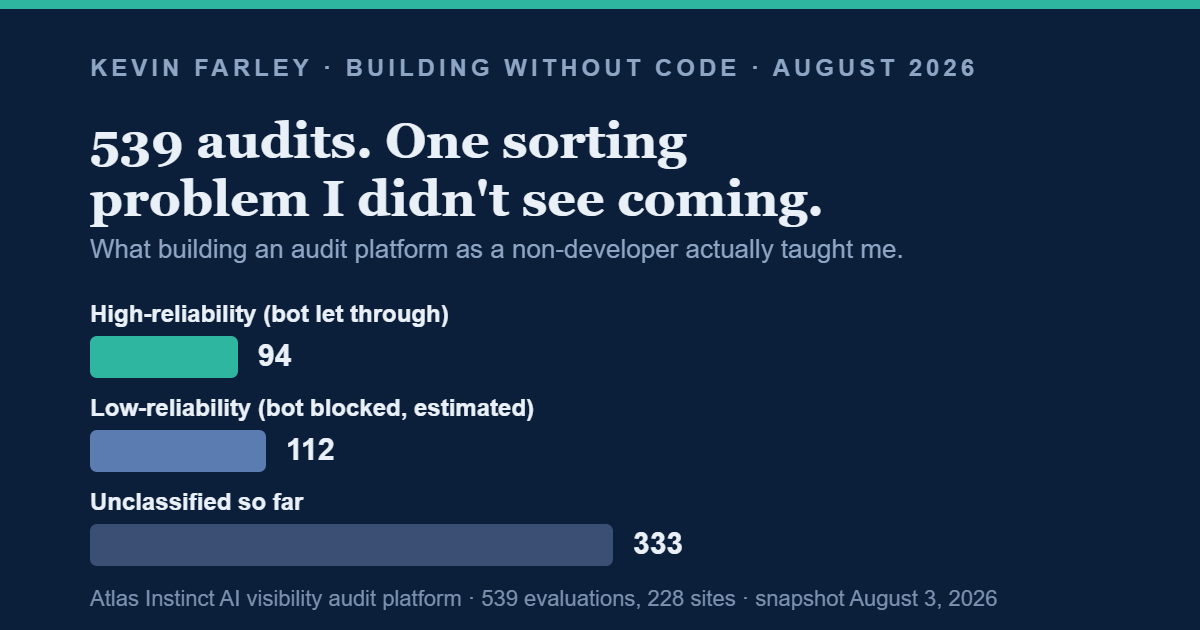
High-reliability audit: an audit where the institution’s website allowed the crawler through, so the score reflects the page content that was actually read.
Low-reliability audit: an audit where the website blocked the crawler, so the score is an estimate rather than a direct measurement.
Of the 539 audits as of August 3, 2026, only 94 (17%) are high-reliability. Another 112 (21%) are low-reliability. The remaining 333 haven’t been sorted into either bucket yet, and I don’t fold them into “blocked” claims, because I don’t actually know that about them.
I don’t publish institution-level claims off anything but the high-reliability set. Aggregate stats can use the full dataset, as long as I say so and date-stamp the count. That rule is why the published benchmarks and the state-by-state credit union index are scoped the way they are. It exists because I built the sorting mechanism myself and watched what happens without it.
Does blocking AI crawlers hurt your AI visibility?
Yes, and this is the part that should get more attention than it does. A meaningful share of the financial institutions this platform audits are blocking the very bots that determine whether AI systems can recommend them. Reasonable security posture, real caution about unknown traffic, and a side effect nobody on the security team was thinking about when they wrote the firewall rule. You cannot know your AI visibility score if your own infrastructure won’t let the thing measuring it through the door.
I don’t think that’s a knock on any single institution. It’s a structural blind spot built into how most websites treat unfamiliar crawlers, and it’s the kind of finding a spreadsheet of vendor-reported averages would never surface, because nobody publishing those averages says how they got measured.
How to check whether your own site is blocking them
You don’t need an audit platform to answer this. Three checks, and none of them take longer than a coffee.
- Read your robots.txt. Load yoursite.com/robots.txt in a browser and look for
GPTBot,ClaudeBot,PerplexityBot,OAI-SearchBot, andGoogle-Extended. ADisallowunder any of those means you have opted out of that engine reading you. - Ask whoever owns your WAF or CDN. Cloudflare, Akamai, and most managed hosts ship bot-protection rules that block unrecognized crawlers by default, and those rules are invisible in robots.txt. This is where most of the blocking I see actually lives, not in the file everyone checks.
- Ask the engines directly. Open ChatGPT or Perplexity and ask it to describe your institution. If the answer is thin, generic, or wrong, something upstream is not getting through.
A blocked crawler and a badly structured page produce the same symptom, which is why the third check matters. If you want the longer version of that diagnostic, I wrote up five checks to run on any AI search claim, and a plain-language explainer on what generative engine optimization actually is.
If you run marketing at a credit union, a bank, or a fintech selling into one, the checks above will tell you whether the crawlers can reach you. What they will not tell you is how the answer engines actually describe you once they get in. That takes a read of your own site.
Run the free 90-second AI Visibility Check
Prefer to talk it through? Start a conversation with Atlas Instinct. Six questions, runs in your browser, nothing stored.
What “non-developer” actually meant in practice
I want to be specific about this, because “I built a platform” can sound like a bigger leap than it was. I didn’t write the scoring logic from scratch. I described what I wanted, reviewed what came back, argued with it when the output was wrong, and rebuilt sections that didn’t hold up under real data. That’s closer to editing than engineering. It’s also, I think, the actual shape of the skill marketers need next.
Marketing roles are changing verbs, not disappearing. The people who get hired into the AI-search and AEO roles opening up right now aren’t necessarily the ones who can write production code. They’re the ones who can direct a build, catch a bad assumption in the output, and insist on a reliability flag when the numbers look too clean. Judgment stays human. The tool just makes the judgment cheaper to act on. I went deeper on which marketing roles this actually changes earlier this year.
What I’d tell someone starting from zero
Start with the question you actually want answered, not the tool you think you need. I wanted to know whether AI systems could see specific financial institutions clearly. Everything else, the crawl logic, the scoring categories, the reliability flags, got built to answer that one question, in order, as each gap showed up.
And expect the ugly middle. The templated fallback scores I described above sat in the dataset for weeks before I noticed the pattern. Nobody flags that for you. You have to go looking, on a dataset large enough that patterns actually show up, which took time to accumulate.
The applied version of this same problem, what it means for a credit union or fintech trying to figure out whether their own site is one of the blocked ones, is the subject of this week’s piece on Atlas Instinct, on GEO for fintechs selling into the credit union space. For the institution-side view, see AI visibility for banks and credit unions.
Based on the audit platform built for Atlas Instinct, 539 evaluations across 228 sites as of August 3, 2026.
FAQ
Does blocking AI crawlers hurt your AI visibility?
Yes. If your site blocks GPTBot, ClaudeBot, PerplexityBot, or similar crawlers, those engines cannot read your pages, so they fall back to whatever they can find elsewhere. Blocking is often set at the WAF or CDN layer rather than in robots.txt, which is why many institutions do not know they are doing it.
How can I tell if my site is blocking AI crawlers?
Check three things: your robots.txt for Disallow rules on GPTBot, ClaudeBot, PerplexityBot, OAI-SearchBot, and Google-Extended; your WAF or CDN bot-protection settings, which block unrecognized crawlers by default on many managed hosts; and the engines themselves, by asking ChatGPT or Perplexity to describe your organization and seeing how thin the answer is.
Do you need to be a developer to build a tool like this?
No. I directed an AI coding tool through the build, reviewed its output, and rebuilt what didn’t hold up under real data. That’s closer to an editing skill than an engineering one, though it still requires enough judgment to catch a wrong assumption before it becomes a published number.
What’s the difference between a high-reliability and low-reliability audit?
A high-reliability audit is one where the institution’s site let the crawler through, so the score reflects real page content. A low-reliability audit is one where the site blocked the crawler, so the score is an estimate rather than a direct measurement.
What did building this teach you about marketing as a skill?
That the useful skill isn’t writing code. It’s directing a build, reviewing its output critically, and knowing when a number looks too clean to trust. Judgment stays human even as more of the mechanical work gets automated.
About the author
Kevin Farley spent 13 years running marketing inside a Texas credit union that grew from $725M to $1.6B in assets, and now leads Atlas Instinct, an advisory firm focused on AI visibility for financial institutions, fintechs, and law firms. He built and runs the AI visibility audit platform this post describes. Reach him at atlasinstinct.com/contact.